

THUNDERBOLTS ⚡️




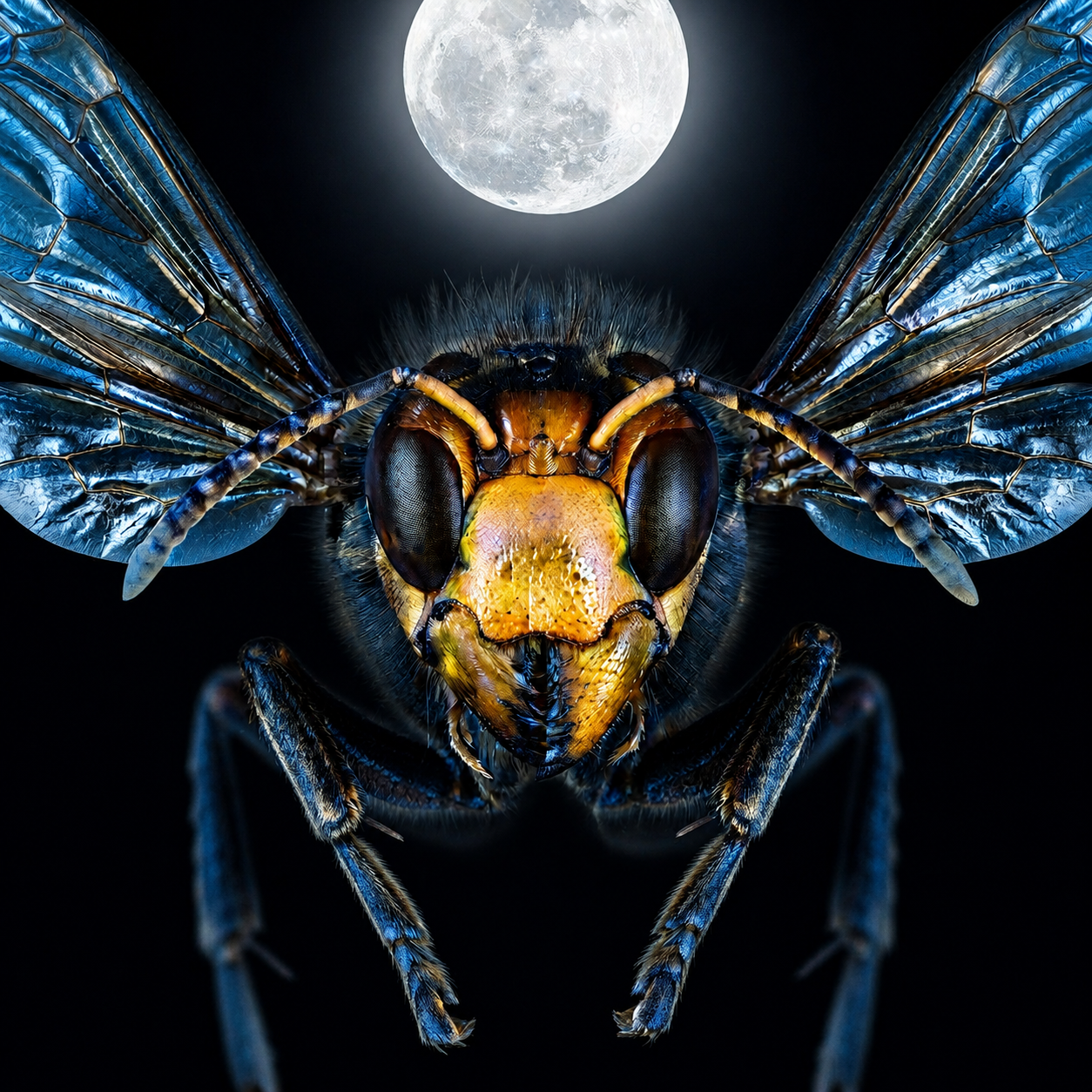
Asian Giant Hornet
Vespa mandarinia Smith, 1852
Asian Giant Hornet
Vespa mandarinia Smith, 1852
“The World’s Largest Hornet”
This specimen is displayed under dramatic lighting to highlight the iridescence of its wings and the power of its form. In nature, Vespa mandarinia commands both fear and fascination. Native to temperate and tropical forests of East Asia, this insect is an apex predator in its ecosystem.
Identifying Features
• Size: Queens reach 50 mm (2 in) in length with a 76 mm (3 in) wingspan. Workers are slightly smaller. • Coloration: Distinctive orange head, dark brown thorax with black markings, and a yellow-and-black banded abdomen. • Mandibles: Large, orange, and serrated — adapted for tearing apart prey. • Stinger: 6 mm long, capable of delivering venom containing mandaratoxin, a neurotoxin.
Ecology & Behavior
Asian giant hornets are eusocial, living in underground colonies that may contain hundreds of individuals. They are infamous for their “slaughter phase,” during which a small group can decimate an entire honeybee hive in hours to feed developing larvae. Despite their reputation, they are not aggressive toward humans unless defending their nest.
Range & Status
Native to Japan, Korea, China, and parts of Southeast Asia and Russia. Since 2019, isolated populations have been detected in North America, prompting monitoring due to their potential impact on local pollinators. They are not endangered.
Did You Know?
In Japan, they are called ōsuzumebachi (大雀蜂), literally “great sparrow bee,” a reference to their size. Beekeepers in their native range have developed defensive strategies, and some honeybees have evolved a unique “heat balling” behavior to kill invading hornets.
Specimen photographed with lunar backdrop to evoke the nocturnal myths often associated with this insect, though the species is primarily diurnal.
THUNDERBOLTS⚡️ 🎬
https://www.instagram.com/reel/DaOdnSdp--L/?igsh=MWJjZ2V0b2x5NWdtNg==

EASTWINDPOEMS.SITE
