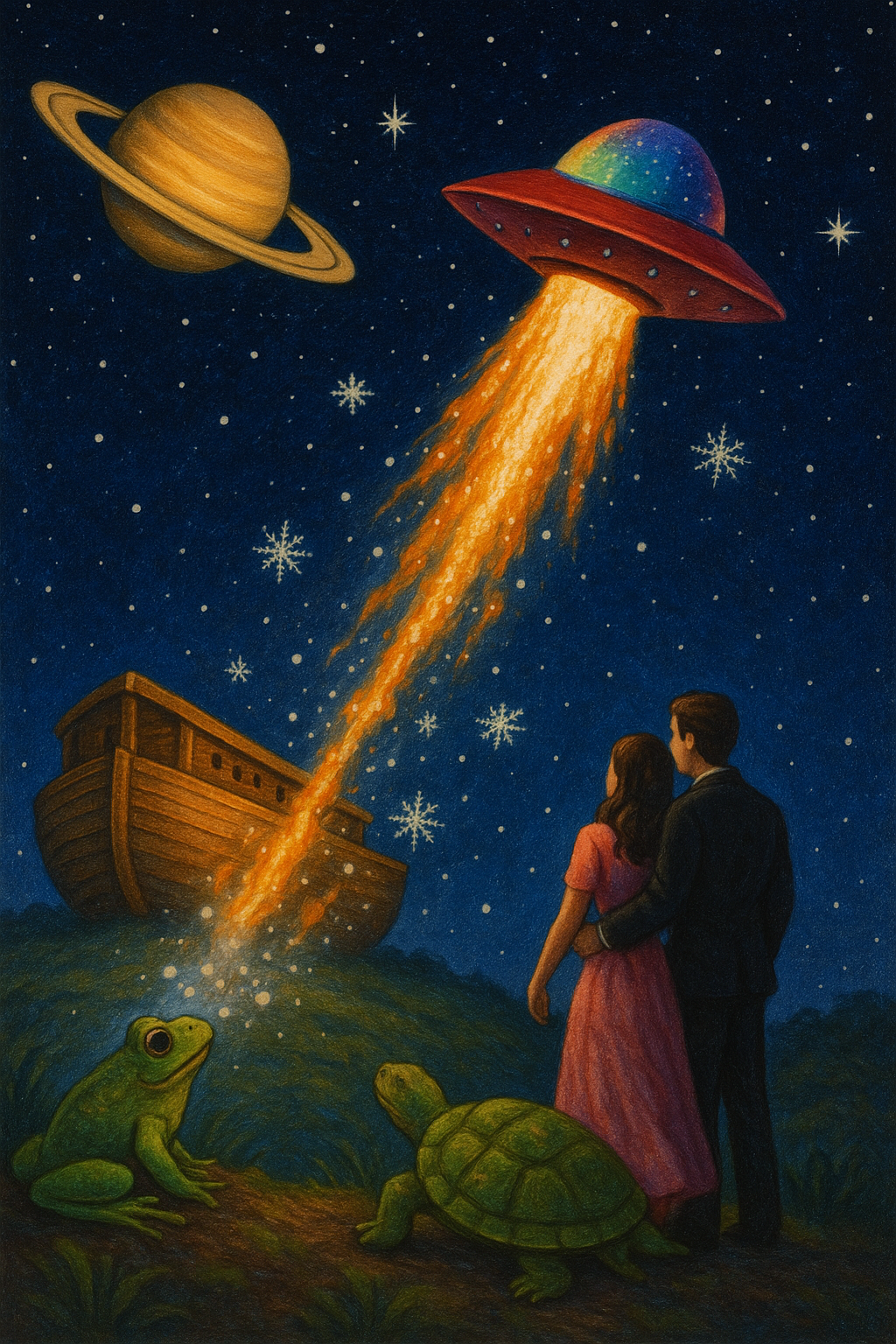
Stardust and Ice Crystals Hold Together
www.eastwindpoems.site
© All Rights Reserved.
Unauthorized copying, reproduction, distribution, or adaptation of this work—whether in part or in whole—is strictly prohibited. No content may be used without express written permission from the author.
Stardust and Ice Crystals Hold Together
The Unmelted Flake
By Scott L.
A single flake fell softly from the height,
Its stardust heart unchanged by flame or flight;
It drifted down where meadow blossoms wake,
A miracle the morning couldn’t break.
It touched the frog — a spark of ancient grace —
And stirred remembrance in that humble place;
The wild forget-me-nots began to shine,
As though they’d heard a distant, holy Sign.
No fire could claim it, time could not erase;
It lived where God had set His quiet trace.
The frog looked skyward, wide-eyed at the truth:
That life remembers Him who shapes all youth.
So fell the flake no earthly heat could take —
God willed it so… and nothing made it break.
HELD TOGETHER
The Theology of the Unmelted Flake
Commentary Summary
In this sonnet, the unmelted flake—snowborn stardust that refuses to yield—stands as the quiet emblem of a human soul unbroken under pressure. In life, people often feel fragile—worn down by stress, heat, and the unrelenting demands of the world. Like a snowflake in fire, we expect ourselves to dissolve, to break apart, to melt under the weight of circumstance.
Yet we remain.
The sonnet’s miracle—a snowflake descending through flame unchanged—reflects the mystery of divine sustaining power. It is not the flake’s strength that keeps it whole, just as it is not our strength that keeps us standing. The flake holds together because God wills it so, echoing the truth found in Colossians 1:17:
“He is before all things, and in Him all things hold together.”
This is the heart of the theology behind the image:
The fire represents the pressures of life.
The snowflake represents the human soul—delicate, vulnerable.
Its indestructibility represents the sustaining presence of God.
The miracle is never explained in the poem. It simply is.
And because it is not explained, the reader instinctively reaches for the divine to understand it. This is how spiritual art works: it invites, it whispers, it beckons the heart toward God without force or argument.
In the meadow, the frog becomes the humble witness to this wonder, reminding us that the small, the overlooked, and the meek often see God’s hand first. The forget-me-nots shine as symbols of remembrance—creation waking to God’s presence again.
In this way, the sonnet becomes a parable of endurance, grace, and divine sustaining love.
We stand not because of our strength,
but because of His.
This is the theology of the Unmelted Flake:
A fragile life held together by an unbreakable God.