

My Friend George
By Scott L.
eastwindpoems.site
Before the United States existed as a nation, it existed first as an argument—an uncertain belief that liberty, self-government, and individual rights could survive against one of the world’s most powerful empires.
In the streets and harbor of Boston, tensions between the colonies and the British Crown continued to rise through taxation, military occupation, trade restrictions, and growing frustration over representation and political authority. Events such as the Boston Tea Party became symbolic of a deeper fracture already forming beneath the surface.
For many colonists, the struggle was not viewed solely through politics or economics, but also through conscience, moral conviction, and the belief that liberty itself carried spiritual weight. Ideas of natural rights, self-governance, and human dignity increasingly shaped the emerging American identity.
In Philadelphia, figures such as Thomas Jefferson, Benjamin Franklin, and John Adams helped shape the Declaration of Independence, transforming colonial frustration into a written argument for liberty, self-governance, and the right of a people to determine their own future.
What followed was not immediate triumph, but years of sacrifice, bitter winters, battlefield deaths, uncertainty, and endurance carried largely by ordinary people whose names history rarely remembers. The birth of the nation emerged not through abstraction alone, but through hardship, discipline, suffering, and the willingness to hold the line when collapse often seemed closer than victory.
From the frozen crossing at the Delaware to the surrender at Yorktown, the Revolution became more than war. It became the shaping of an American identity still unfolding through sacrifice, resilience, unity, and the pursuit of liberty under law.
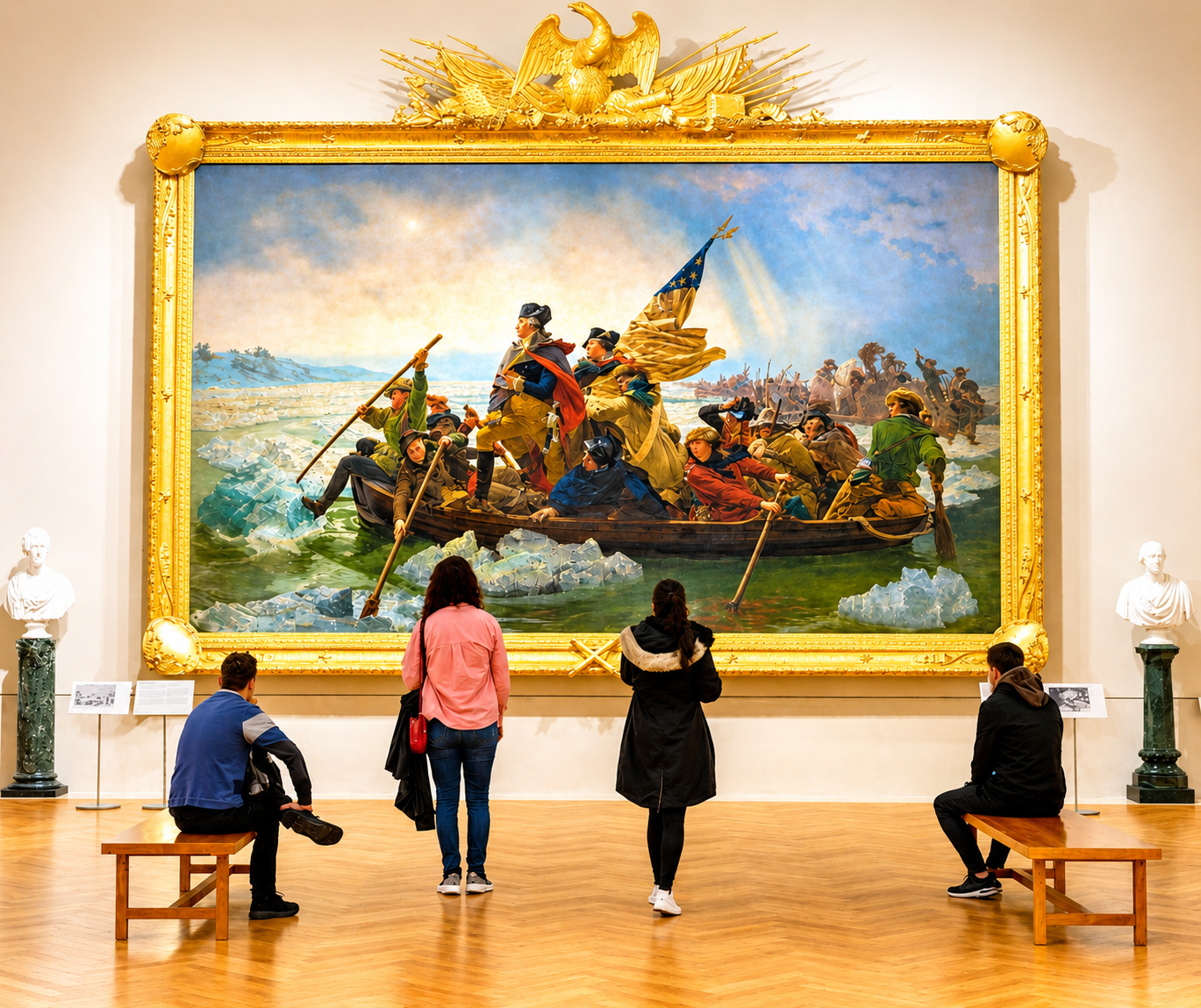
Washington Crossing the Delaware
By Emanuel Leutze — 1851
Depicting General George Washington leading Continental Army troops across the icy Delaware River before the Battle of Trenton during the American Revolutionary War.
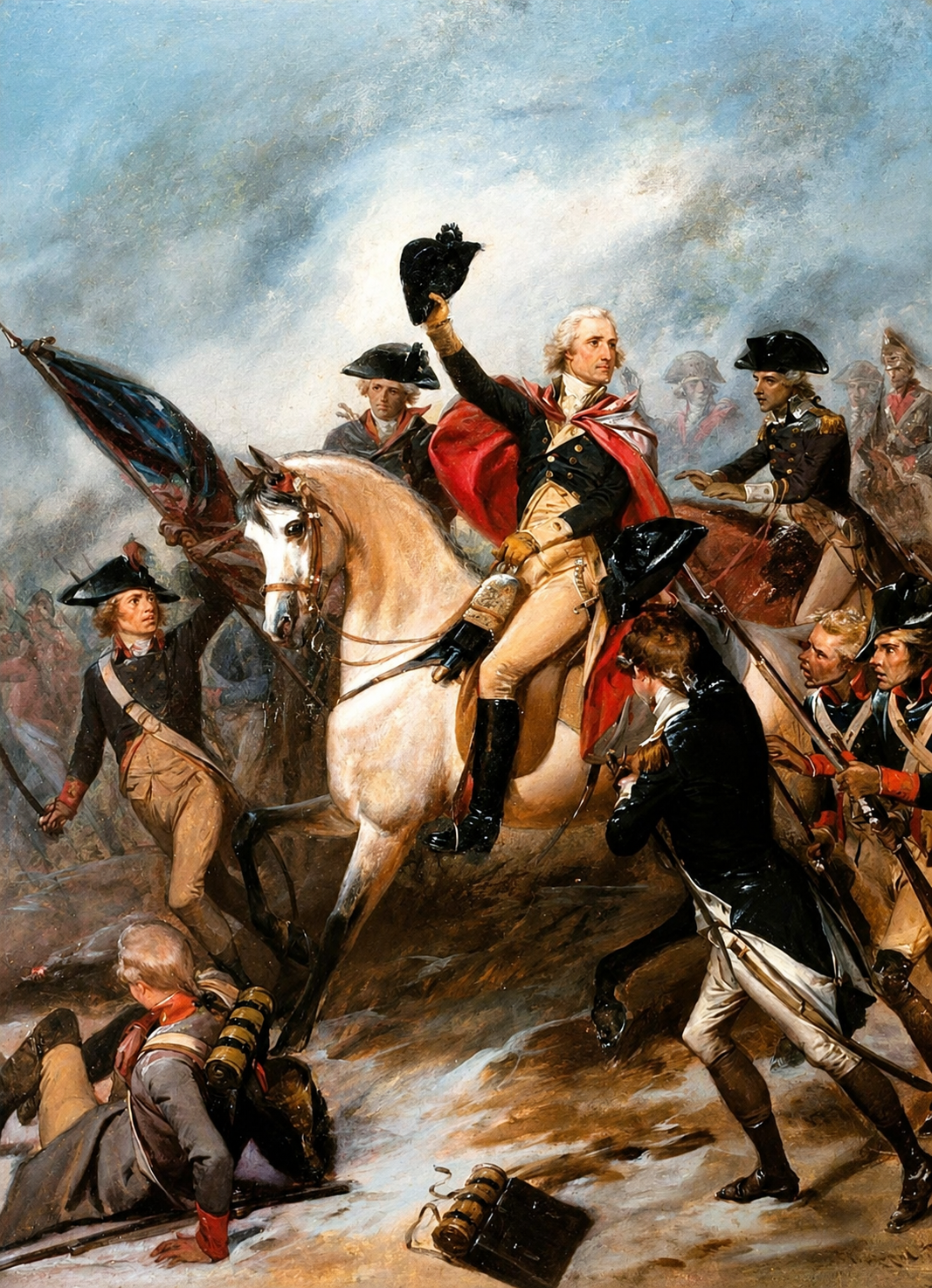
Washington Holding and Rallying the Troops at Monmouth
By Emanuel Leutze
Depicting General George Washington restoring order and holding the Continental line during the Battle of Monmouth in 1778.
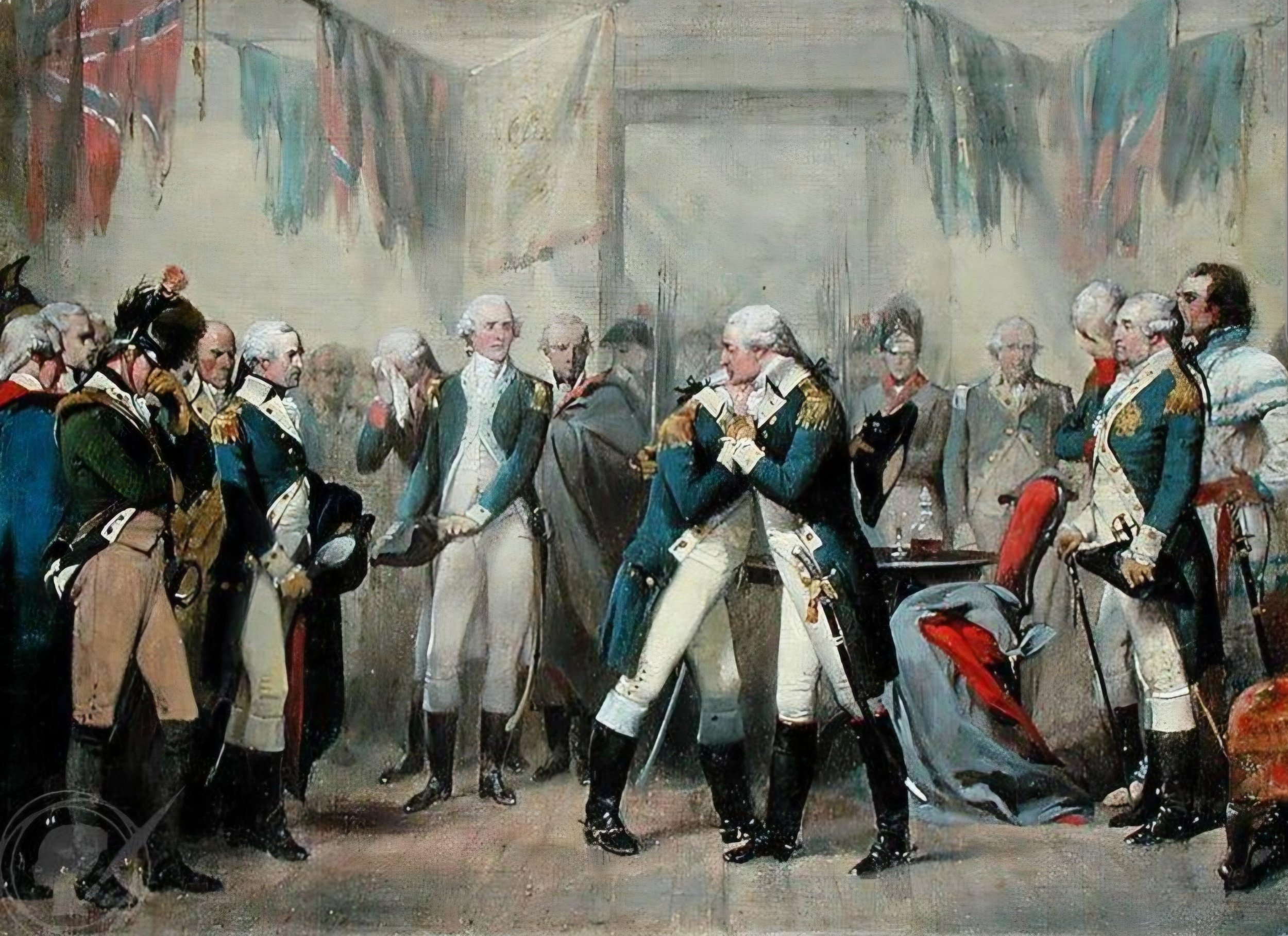
George Washington embracing the Marquis de Lafayette
Attributed to Alonzo Chappel
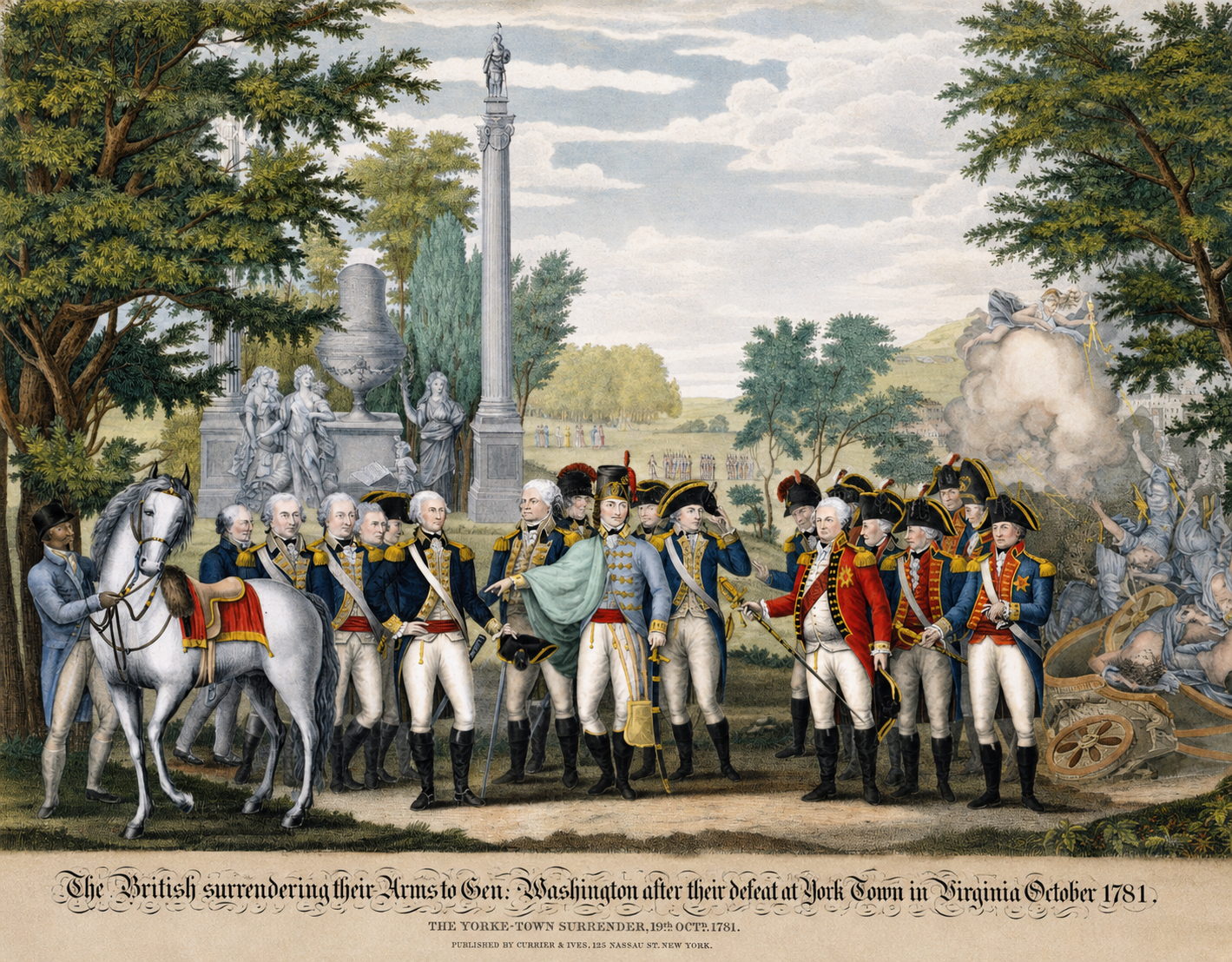
The British surrendering their arms to General George Washington after the defeat at Yorktown, Virginia — October 1781
Featuring British General Charles O'Hara, who formally represented Charles Cornwallis at the surrender.
After the historical compositions associated with John Trumbull and later patriotic engravings.
The British Surrender at Yorktown
At the decisive conclusion of the Siege of Yorktown in October 1781, the British Army faced an outcome that had become unavoidable. Surrounded by combined American and French forces under General George Washington and the Comte de Rochambeau, British commander Lord Charles Cornwallis found his army trapped, exhausted, and cut off from meaningful escape or reinforcement.
Yorktown would become the final major military confrontation of the American Revolutionary War and one of the defining symbolic moments in American history.
Yet one of the most remembered details of the surrender is that Cornwallis himself did not appear at the formal ceremony.
Claiming illness, Lord Cornwallis remained absent and instead sent his second-in-command, General Charles O’Hara, to formally surrender the British army. Historians continue to debate whether Cornwallis was genuinely ill, protecting his dignity, or avoiding the humiliation of public defeat.
The symbolism of the moment mattered enormously.
When O’Hara approached the allied commanders, he first attempted to surrender directly to Washington. Washington, however, refused to personally receive the surrender. Instead, he directed O’Hara to Major General Benjamin Lincoln.
This decision carried deliberate historical meaning.
Only a year earlier, Benjamin Lincoln had been forced to surrender the American city of Charleston after bitter sacrifice and humiliating circumstances. The British had denied Lincoln traditional honors of war during the ceremony at Charleston. By appointing Lincoln to receive the surrender at Yorktown, Washington answered humiliation not with spectacle or revenge, but with restraint, discipline, and historical symmetry.
The ceremony itself reflected that restraint.
Rows of British soldiers marched forward and laid down their arms while American and French troops stood in formation beneath the autumn sky. Drums echoed across the field. Flags shifted in the wind. Years of violence collapsed into ritual, silence, and order.
Washington’s conduct during the surrender became part of his enduring reputation. He did not publicly celebrate, mock the defeated, or indulge in triumphalism. Instead, the moment emphasized command presence, discipline, and legitimacy.
The emerging United States presented itself not simply as a rebellion victorious in war, but as a nation capable of dignity and restraint at the height of victory.
The freedoms later protected within the United States Constitution did not emerge without cost. They followed years of sacrifice, uncertainty, bitter fighting, and the spilling of blood during the struggle for independence. Ideas such as liberty, ordered government, and individual rights carried weight because they had first carried sacrifice.
Artists later transformed Yorktown into one of the defining visual myths of American history. Paintings such as The Surrender of Lord Cornwallis by John Trumbull immortalized the ceremony as more than military defeat—it became a symbolic transfer from conflict into nationhood, from fracture into order, and from war into historical memory.
Historical Reflection
The Lincoln who received the British surrender at Yorktown was not Abraham Lincoln, but General Benjamin Lincoln of the Revolutionary War generation. The coincidence of the name creates an unusual echo across American history—one Lincoln connected to the birth of the nation, another, nearly a century later, struggling to ensure that the nation itself would not perish.
Reflection
History often reveals itself this way—not all at once, but through discovery.
A painting leads to a question.
A question leads to a forgotten figure.
A forgotten figure reveals a deeper symmetry hidden beneath the surface.
What first appears to be simple patriotism becomes something more layered: dignity restored through restraint, leadership expressed through discipline, and a nation shaped not only by victory, but by the manner in which victory was carried.
In this way, history becomes less like memorization and more like exploration—an unfolding search through symbols, echoes, sacrifice, and human character.
Almost like treasure hunting.
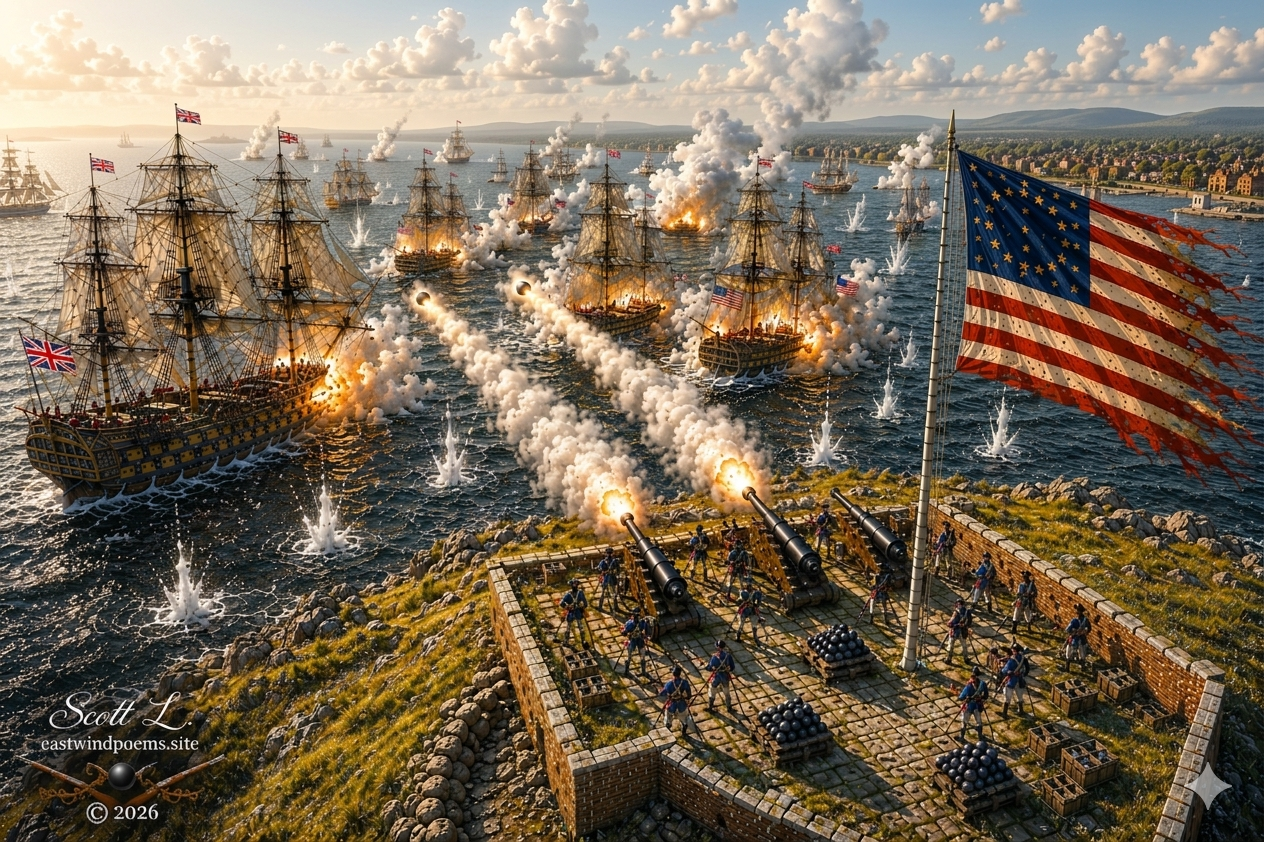
Before Dawn’s Early Light
AI-created, conceptualized, and crafted by Scott L.
Depicting the bombardment of Fort McHenry during the War of 1812 beneath the smoke, cannon fire, and early light that later inspired The Star-Spangled Banner.
eastwindpoems.site
© 2026 Scott L. All rights reserved.
