⛈️ Ben’s Kite Experiment 🪁🗝
⛈️ Benjamin Franklin and the Lightning Experiment 🪁 🗝
By the middle of the eighteenth century, electricity was one of the great scientific mysteries of the age.
Researchers in Europe and America were producing static electricity with glass tubes and globes. They watched sparks jump through the air. They discovered that electrical charge could be conducted, stored, and discharged. Some scientists had already noticed something remarkable: the tiny electrical sparks created in their laboratories looked and behaved surprisingly like lightning in the sky.
Benjamin Franklin became fascinated by the connection.
By 1749, Franklin had begun systematically comparing electricity with lightning. He listed a series of similarities between the two and wondered whether they were not merely similar, but actually the same natural phenomenon.
There was another observation that particularly interested him.
Franklin had discovered that pointed metal objects interacted very effectively with electrical charge. If lightning was electrical, he reasoned, perhaps a pointed metal conductor raised toward a thundercloud could collect electricity from the atmosphere.
But a hypothesis was not enough.
It had to be tested.
In 1750, Franklin proposed an experiment using a tall pointed iron rod. His idea eventually crossed the Atlantic and attracted considerable attention in France. On May 10, 1752, French experimenters working from Franklin's proposal successfully drew electrical sparks from a tall iron rod during a storm at Marly-la-Ville near Paris.
Franklin's prediction was working.
Meanwhile, in Philadelphia, Franklin faced a practical problem. He had originally considered using a tall tower or church steeple to raise his conductor toward the clouds.
Then came a wonderfully simple idea.
Why wait for a tower?
A kite could reach the sky.
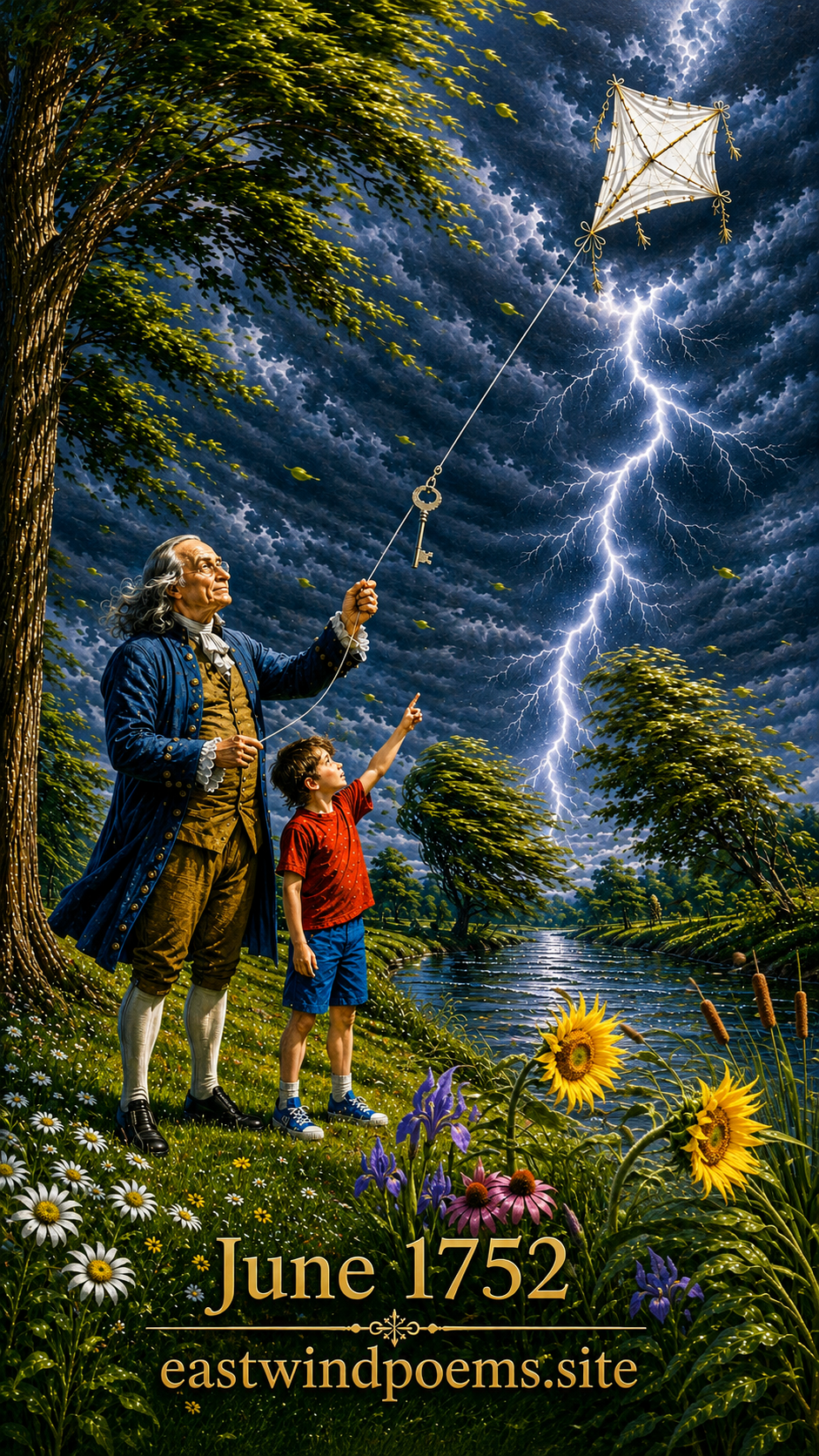
Sometime in June 1752, according to the surviving historical account, Franklin went out during an approaching thunderstorm with his son William.
The kite was constructed to withstand the wet and wind of the storm. A sharp metal wire extended above it. Hemp twine descended from the kite, while a silk ribbon near Franklin's hand helped provide insulation as long as it remained dry.
And attached near the lower end of the twine was an ordinary metal key.
The key would become one of the most famous objects in the history of science.
As the storm cloud moved overhead, Franklin waited.
Nothing happened at first.
Then he noticed something.
Loose fibers on the hemp string began standing outward.
The apparatus was becoming electrically charged.
Franklin brought his knuckle close to the metal key.
A spark jumped.
That tiny spark was the important moment.
Contrary to the familiar paintings and illustrations of the experiment, a lightning bolt did not strike Franklin's kite or key. A direct lightning strike could have killed him. Instead, the kite apparatus collected electrical charge associated with the storm cloud, and the wet hemp string conducted that charge downward to the key.
Franklin could draw sparks from the key.
More importantly, he could use the electricity collected from the storm to perform the same kinds of experiments scientists performed with electricity generated in the laboratory.
The implication was extraordinary.
The electricity produced by their machines and the electrical phenomenon occurring in thunderstorms were manifestations of the same thing.
Lightning was electrical.
The experiment did not mean Franklin had “discovered electricity.” Human beings had observed electrical effects long before Franklin was born, and eighteenth-century scientists were already actively studying them.
Franklin's achievement was different.
He helped turn a suspected connection between electricity and lightning into something that could be experimentally tested and demonstrated.
And Franklin was interested in more than proving a scientific theory.
He wanted to put the discovery to work.
If pointed metal could interact with atmospheric electrical charge, perhaps buildings could be protected from lightning.
That reasoning helped lead to the lightning rod.
A lightning-protection system places a metal rod or air terminal at a high point on a structure and connects it through conductive material to the earth. If lightning strikes the protected system, the conductors provide a deliberate low-impedance path for the enormous electrical current to travel toward the ground rather than forcing it through vulnerable parts of the building.
Franklin began installing and promoting such protective systems in the same period as his atmospheric electrical experiments.
The idea was beautifully practical.
Understand nature first.
Then use that understanding to protect human life and property.
That is why the image of Franklin, the kite, and the key has endured for nearly three centuries.
The dramatic story is not really about a man deliberately catching a bolt of lightning.
It is about something much smaller.
A kite rose into a storm.
Electrical charge traveled down a wet string.
A man moved his hand toward a key.
And a spark crossed the gap.
In that tiny flash was evidence of something enormous:
The electricity being studied on the laboratory table and the lightning illuminating the heavens belonged to the same natural world.
🎬
⛈️ Ben’s Kite Experiment 🪁 🗝
https://www.instagram.com/reel/Db_DY5MO4xX/?igsh=aHpweWprN2Rlc3px
Author’s Note
There is one detail behind this story that I found especially fascinating.
Benjamin Franklin was not alone when he conducted his famous kite experiment in June 1752. According to the later historical account of the experiment, his son, William Franklin, was there with him.
The young boy pictured in the accompanying illustration should not be taken literally as William. By 1752, William was already a young man. The child in the image is an artistic representation of the wonder and curiosity surrounding the experiment.
Still, knowing that Franklin's son actually stood beside his father that day adds something remarkable to the story.
We remember the kite.
We remember the key.
We remember the storm.
But there were two people standing beneath that sky.