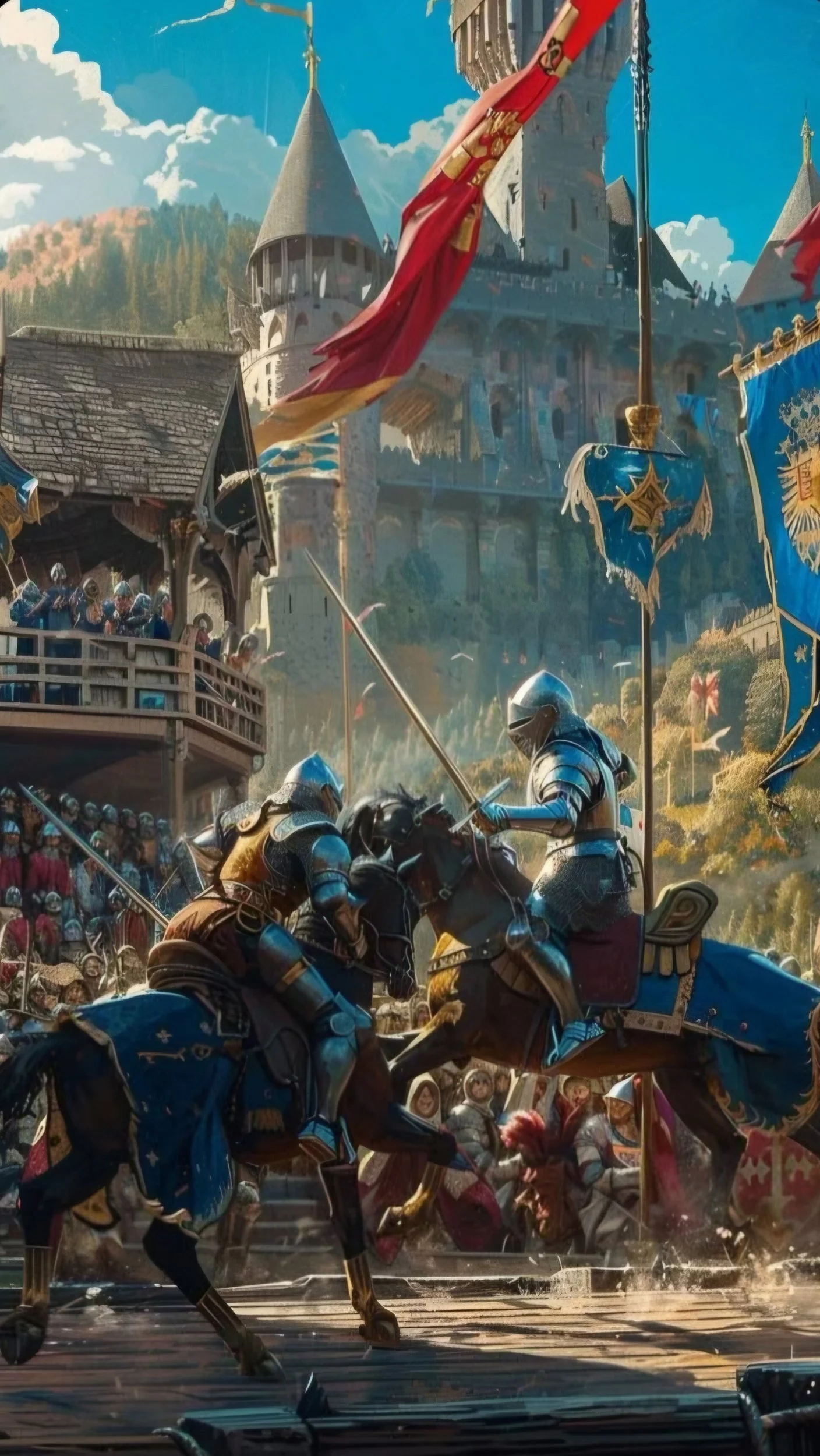
King Richard III: Justice by Combat ⚔️
Trivial Info, Heads Up: Scott L.’s birthday is October 7, 1969—he is all Libra, Libra all the way. This is a long piece, and it may take a little while to read. You might want to find a quiet moment, a Green Meadow of your own, before diving in.
In the quiet of a Green Meadow, children toss corn husks, laughter rises from evening cookouts, and iced tea cools in the soft breeze. It is here, between play and reflection, that we can approach the world of Richard III—not merely a tale of ambition and deformity, but a story that invites us to ask: how did justice once work, and how might it be imagined differently today? Shakespeare’s stage may have echoed with swords and cunning, yet the true measure of a man—or a society—resides in courage, integrity, and the choices we make beyond the battlefield.
Historical Landscape
When we look back at Richard III, we also step back into a complicated landscape of English history. The Hundred Years’ War had ended decades before Richard’s birth, leaving a country weary of battles with France. What followed were the Wars of the Roses, a series of internal conflicts between the House of Lancaster, marked by the red rose, and the House of York, marked by the white rose. These were not battles of foreign kings, nor were they single events; they stretched across decades, shaping loyalties, ambitions, and the very idea of what it meant to claim a throne.
Shakespeare did not write a play called the Wars of the Roses—he dramatized these wars across several history plays, Henry VI, Parts 1–3, and Richard III, compressing years of dynastic struggle into moments of cunning, courage, and brutality.
— ✦ —
Standing in the quiet of a Green Meadow, listening to the laughter of children tossing corn husks or singing under the evening sun, one begins to feel the weight of history without the clamor of battle. There, the lessons of Richard’s world—the interplay of might, strategy, and survival—take on a new life. Justice by combat may have ruled then, but here, we see that true strength may lie in hearts and minds, in courage and integrity, far beyond the reach of swords.
Richard III: Body and Mind
Shakespeare’s Richard III is unforgettable not just for his ambition, but for the way his very body seems to mirror his cunning and ruthlessness. On stage, he is described as hunchbacked, with a twisted arm and a limp—physical markers of a mind set apart, a soul sharpened by the world’s rejection. Historically, Richard did have scoliosis, but the dramatic exaggeration transforms him into a living symbol of moral complexity: a man whose cunning and ambition are inseparable from the obstacles he faces, both real and perceived.
In the quiet of a Green Meadow, watching children chase each other and toss corn husks, one can almost hear Richard’s story in a new way: not simply as a tale of villainy or power, but as a reflection on how society judges and responds to difference, how strength and survival were intertwined, and how the measure of a person was often decided by fate, strategy, or sheer might.
Shakespeare sharpens history, showing that in a world where justice was often decided by combat, the human heart and mind must navigate far more subtle—and lasting—battles.
Reflection on Justice
Looking back from our own time, we cannot help but ask why the world once measured right and wrong by the sword, by cunning, by survival. Why did strength define justice, and why did defeat mark one as morally or socially “wrong”? These questions are not meant to judge the past, but to understand it—to see the rhythms of human behavior, the pressures of ambition, and the stark realities of survival in a brutal age.
In Shakespeare’s Richard III, these forces are magnified, showing a world where power and might dictated the course of life and death. Yet, in the quiet of a Green Meadow, where children toss corn husks, laughter rises around evening cookouts, and iced tea is lifted in simple celebration, we recognize a different form of justice: one shaped by values, compassion, integrity, and human connection. The contrast invites reflection, reminding us that while the world changes, the lessons of history—ambition, courage, and the consequences of our choices—remain timeless, waiting to be understood and carried forward.
Richard III as Mirror
Richard himself becomes a mirror for this reflection. On stage, he is larger than life—ambitious, cunning, and ruthless—yet Shakespeare does not present him as a simple villain. His deformity, his outsider status, and his unrelenting drive force us to consider the human cost of a world where might decides right. In his victories and his downfall, we see the consequences of ambition untempered by empathy or shared values.
And when we step away from the battlefield of history, away from the courtly intrigue and the clash of swords, we can view Richard through a different lens: as a man shaped by his environment, as a product of a society in which justice was inseparable from power.
In the quiet of a Green Meadow, amidst the play of children and the songs rising from evening cookouts, his story becomes a teaching moment, urging us to ask not just who won or lost, but why we have reimagined justice and moral measure in our own time, and how we might choose differently in the present.
Justice by Combat
At the heart of Richard III’s story lies the motif of Justice by Combat—a world where strength, cunning, and survival dictated who was “right” and who was “wrong.” Shakespeare dramatizes this not merely to thrill, but to reveal the harsh logic of a society where victory validated morality, and defeat marked failure.
In our time, we no longer settle disputes with swords or battles, yet the echoes remain: in politics, in social hierarchies, even in personal ambition, the question of how power shapes judgment still resonates. And yet, standing in a Green Meadow, watching children toss corn husks, hearing the laughter around evening cookouts, we see a different form of justice take root. Here, right and wrong are measured not by might, but by integrity, courage, empathy, and the willingness to act with care toward others.
Shakespeare’s Richard III, with all his ambition and cunning, thus becomes more than a historical figure or stage villain—he is a lens through which we can examine our own values, asking why the past was as it was, and how we might choose differently in the present.
Lessons for Today
In the end, Richard III’s world and ours are separated by centuries, yet the lessons remain strikingly relevant. Shakespeare distilled decades of dynastic struggle, political intrigue, and human ambition into a story that still challenges us to ask: what is justice, and who decides it?
From the brutal logic of might and survival in the Wars of the Roses to the quiet, measured choices of daily life, the contrast is clear. In a Green Meadow, surrounded by the laughter of children, the warmth of evening cookouts, and the simple pleasures of community, we see that justice need not be defined by combat or power, but by the courage to act rightly, the integrity to honor others, and the wisdom to learn from the past.
Richard’s cunning and ambition remain a cautionary tale, yet they also remind us of the enduring human capacity to choose empathy over force, reflection over impulse, and shared values over mere survival. History and drama meet here, in memory and imagination, offering both a window to the past and a mirror for our own time.
⚔️